
Investing with a long-term perspective
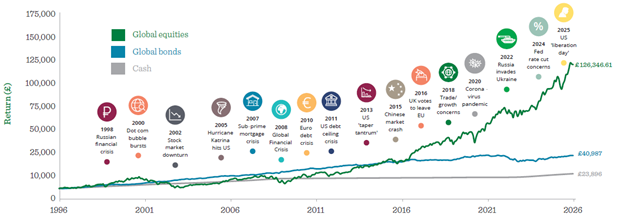
Taking a long-term view helps smooth out short-term market fluctuations and supports more consistent outcomes over time. As illustrated in the chart below, while both equities and bonds experience periods of volatility — often driven by global events — their long-term direction has historically been upward.
Furthermore, global equities over the past 30 years have delivered significant growth despite a wide range of market disruptions. An investment made three decades ago could have grown to more than twelve times its original value. This illustrates the potential benefit of staying invested and avoiding short-term reactive decisions during periods of uncertainty.
Time in the market matters
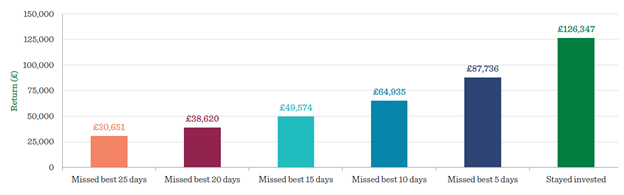
Trying to anticipate market movements or stepping out of investments during uncertain periods can be costly. Some of the strongest market days often occur close to periods of market decline1 and missing even a small number of these days can materially reduce long-term investment returns.
Over the past 30 years, an investor who remained fully invested in global equities achieved significantly higher returns than an investor who missed just the 25 best-performing days.
This reinforces the importance of remaining invested and maintaining a long-term view, even when markets feel uncomfortable.
The role of diversification
Diversification remains one of the most effective tools for managing investment risk. By spreading investments across asset classes, regions and market styles, investors reduce reliance on any single source of return.
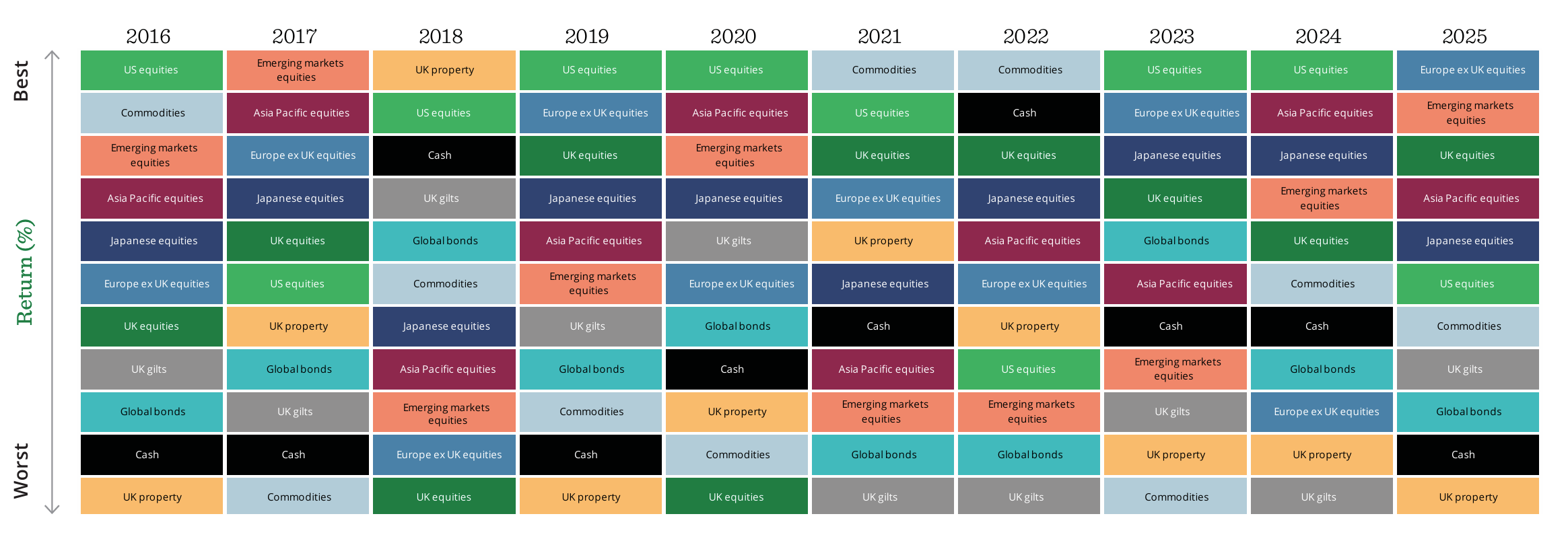
Over the past ten years, performance leadership has rotated frequently between equities, bonds, commodities and property. The strongest-performing asset class in one year has often lagged the following year. This unpredictability highlights why diversification helps build more resilient portfolios over time.
Whilst a diversified approach does not eliminate risk altogether, it does help manage it more effectively, particularly during periods of heightened market uncertainty.
A steady approach
Market uncertainty is a normal part of investing. While short-term volatility can feel unsettling, staying focused on long-term goals, remaining invested and maintaining diversification can help investors navigate these periods with greater confidence.
At Bartlett, we believe clarity, discipline and informed decision-making provide a stronger foundation than short-term reactions to market noise.